

Unity Temple (1905-08) in Oak Park, Illinois, is Frank Lloyd Wright’s church for the town’s Universalist congregation and one of the first public buildings built of exposed reinforced concrete. Designed a few blocks from his home and studio, decades before the Guggenheim Museum, it replaced the traditional church with a cubic, monolithic form, a centralized sanctuary and soft overhead light. It is now part of a UNESCO World Heritage Site and a landmark of modern sacred architecture.
Unity Temple Technical Information
- ArchitectsFrank Lloyd WrightProfile
- Location Oak Park, Illinois, USA View on map →
- ClientUnity Church, Oak Park’s Universalist congregation (today Unity Temple Unitarian Universalist Congregation)
- Project Year1905-08
- Photographs© Xavier de Jaureguiberry
Unity Temple makes an entirely new architecture, and is the first expression of it. That is my contribution to modern architecture
– Frank Lloyd Wright 8


Materiality and Construction: Concrete as an Architectural Choice
Wright saw in this project an opportunity to craft a new architectural language that rejected ornamental, ecclesiastical traditions in favor of an integrated, volumetric composition. Unity Temple set a precedent for modernist explorations in materiality and spatial organization using reinforced concrete, a centralized plan, and an approach to lighting.
One of the most notable aspects of Unity Temple is Wright’s choice of material. Reinforced concrete, a material more commonly associated with industrial applications at the time, became the building’s primary structural and aesthetic element. His decision was driven by economic constraints and a desire to create a unified architectural composition. The resulting structure is a massive, sculptural object that departs from conventional religious architecture.
The monolithic exterior, devoid of steeples or decorative flourishes, presents itself as a contained volume emphasizing inward focus. The lack of ornamentation places all emphasis on form and proportion. The sheer walls and cubic massing create a presence softened by the building’s articulation and interplay of light and shadow.
In many ways, Unity Temple anticipated some principles of Brutalism in its raw material expression while maintaining an atmospheric quality. The challenge, however, was the material’s long-term durability. The fragility of early concrete mixes led to significant deterioration over time, necessitating preservation efforts. While a notable flaw, this material vulnerability does not diminish the architectural intent.
Spatial Experience and Interior Composition
If the exterior of Unity Temple is austere, the interior presents Wright’s spatial planning in full form. Rejecting the longitudinal layout of traditional churches, Wright organized the sanctuary around a centralized plan, reinforcing the egalitarian values of the Unitarian faith. The congregation is not seated in hierarchical rows but within a space fostering collective experience and intimacy.
The multi-tiered balconies create a layering of space, ensuring no one is too far from the pulpit. The tiered seating and spatial compression create a sense of expansiveness despite the building’s relatively modest footprint. This manipulation of spatial depth is reminiscent of Wright’s Prairie School residences, where compression and release guide movement and perception.
A defining aspect of the interior is its treatment of light. Clerestory windows and skylights provide diffused illumination, eliminating direct views to the outside. This removal of distractions encourages contemplation. The golden hues of the plaster walls, combined with the rhythmic play of light, contribute to the atmosphere.
The procession into the temple is carefully orchestrated. Worshippers do not enter directly but are led through a series of compressed spaces before emerging into the sanctuary. This controlled experience reflects Wright’s belief in architecture as an emotional journey, heightening the sense of discovery and focus.
Legacy and Influence on Modern Architecture
Unity Temple was notable in its materiality and spatial organization and its impact on modern architecture. Wright influenced later architectural movements by embracing reinforced concrete and prioritizing spatial experience over historical references.
The influence of Unity Temple can be seen in the work of later architects, from Le Corbusier’s Notre Dame du Haut, which shares a sculptural approach to sacred space, to Louis Kahn’s First Unitarian Church, which also emphasizes light and materiality. Wright’s idea of a unified space is also present in modern civic and cultural buildings.
Despite its design, Unity Temple remains an anomaly within Wright’s work. While its principles were influenced by later projects, few of his subsequent buildings adopted the same monolithic materiality. This raises the question: was Unity Temple a singular experiment or part of a broader architectural philosophy?
Additionally, preservation has been a challenge. The weaknesses of early concrete mixes, combined with exposure to the elements, have necessitated multiple restoration efforts. A major restoration completed in 2017 and its 2019 inscription as part of the UNESCO World Heritage Site The 20th-Century Architecture of Frank Lloyd Wright has helped secure its legacy, yet the dilemma of maintaining early modernist concrete structures remains an ongoing issue.
Unity Temple Plans and Drawings


Unity Temple Image Gallery
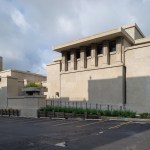


Unity Temple Today
After decades of water damage to its concrete, Unity Temple reopened in 2017 following a 25 million dollar restoration led by Harboe Architects. In 2019 it became part of the UNESCO World Heritage Site The 20th-Century Architecture of Frank Lloyd Wright. The building still serves its Unitarian Universalist congregation and is cared for with the Frank Lloyd Wright Trust.
Visiting Unity Temple
Unity Temple is at 875 Lake Street in Oak Park, Illinois, about 30 minutes west of downtown Chicago by the CTA Green Line. The Frank Lloyd Wright Trust runs guided and self-guided tours most days, subject to church events. Combine the visit with the nearby Frank Lloyd Wright Home and Studio and a walk through the Frank Lloyd Wright Prairie School of Architecture Historic District.
About Frank Lloyd Wright
Frank Lloyd Wright (1867-1959) was an American architect, designer, and visionary who revolutionized modern architecture with his philosophy of organic architecture, emphasizing harmony between human habitation and the natural world. Over his seven-decade career, he designed over 1,000 structures, including Fallingwater, the Guggenheim Museum, and Unity Temple, pioneering innovations in spatial planning, materials, and aesthetics. His Prairie School movement introduced open-plan layouts and horizontality, while his later work explored modular systems and prefabrication. Wright’s influence extends far beyond architecture, shaping modernist thought and inspiring generations of architects worldwide.
Credits and Additional Notes
- Structural System: Reinforced Concrete
- Materials Used: Cast-in-place concrete, plaster, glass, wood
- Design Team: Frank Lloyd Wright & Wright’s Oak Park Studio
- Structural Engineer: Not formally recorded (Wright supervised construction details)
- Landscape Architect: None (Urban setting)
- Restoration Work: Harboe Architects (2015-2017)
- Heritage Status: UNESCO World Heritage Site (2019)
- Frank Lloyd Wright’s Unity Temple: A Good Time Place Reborn by
Unity Temple FAQ
Unity Temple was designed by Frank Lloyd Wright for the Universalist congregation of Oak Park, Illinois, where Wright lived and ran his studio. It was designed in 1905 and completed in 1908.
Unity Temple was one of the first public buildings to use exposed reinforced concrete as both structure and finish. Its cubic massing, centralized sanctuary and indirect light made it a landmark of early modern architecture.
The previous church had burned down and the congregation had a limited budget. Poured concrete was affordable, fireproof and could be cast repeatedly in the same wooden forms, which suited Wright’s modular design.
Yes. In 2019 Unity Temple was inscribed on the UNESCO World Heritage List as part of The 20th-Century Architecture of Frank Lloyd Wright, along with seven other Wright buildings including Fallingwater and the Guggenheim Museum.
Yes. Unity Temple is still an active place of worship, and the Frank Lloyd Wright Trust offers guided and self-guided tours on most days. It is at 875 Lake Street in Oak Park, near the Frank Lloyd Wright Home and Studio.

